
Many people wonder whether to take the pill, have a device placed in the uterus, or keep using condoms only, as they do now. A method that worked well for people around you may not suit you. That is because, even with the same method, how well it fits depends on your health, your daily habits and your plans for the future. This article sets out what to compare when choosing a method for regular contraception.
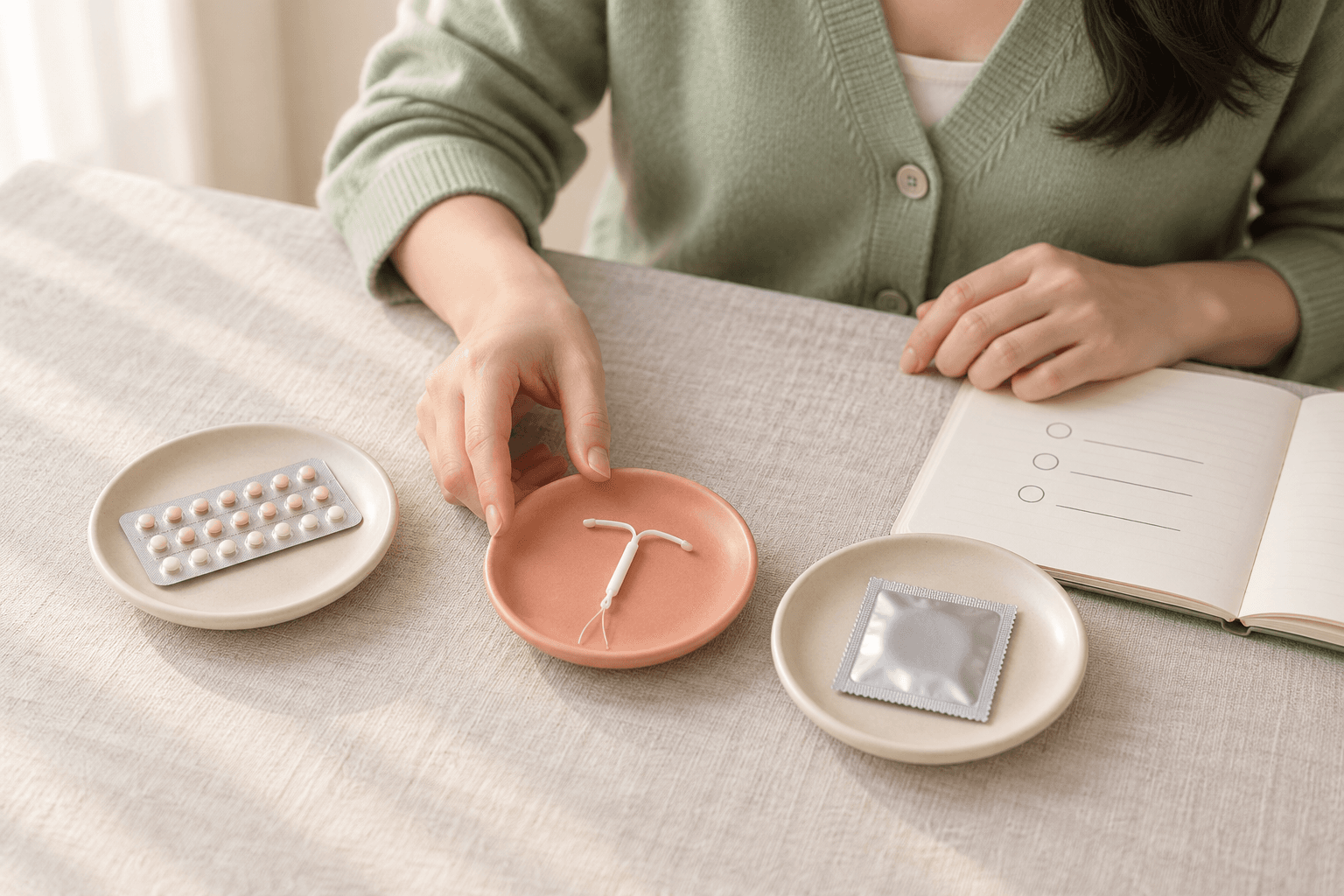
Where should I start when choosing a contraceptive method?
Looking at five things together — effectiveness, how it is used and for how long, your health, changes to your periods and your pregnancy plans — naturally narrows down the options. If you decide on one factor alone, you may find the method inconvenient once you start and end up stopping it.
- Effectiveness: Look at how well it works with typical use — including forgetting or making mistakes — rather than with perfect use exactly as the instructions say.
- How it is used and for how long: Think about which suits your life: a method you take care of every day, one you use each time you have sex, or one that lasts for several years once it is placed.
- Health: Some methods should be avoided depending on smoking, age, migraine, or a history of blood clots or high blood pressure.
- Changes to your periods: Depending on the method, periods may become lighter, irregular bleeding may occur, or periods may become heavier.
- Pregnancy plans: Check roughly when you would like to get pregnant and how quickly things return to how they were after stopping.
This article focuses on the methods compared on LILEAP’s Contraception information page: condoms, oral contraceptive pills, intrauterine devices (copper and hormonal) and the implant placed in the arm. For oral contraceptive pills, it refers to the combined pill, which contains both estrogen and progestin, and mentions other types separately where needed.
Comparing contraceptive methods: how should I read effectiveness?
Comparing methods by their typical-use figures is closer to real life. The U.S. Centers for Disease Control and Prevention (CDC) gives failure rates based on typical use: out of 100 people using a method over a year, how many become pregnant.
| Method | How it is used | Failure rate in 1 year with typical use | Duration of use (per CDC) |
|---|---|---|---|
| Condom (male) | Each time you have sex | 13% | Each time it is used |
| Combined pill | Taken daily | 7% | While you take it |
| Copper IUD | Left in place in the uterus | 0.8% | Up to 10 years |
| Hormonal IUD | Left in place in the uterus | 0.1–0.4% | 3–8 years, depending on the product |
| Implant | Left in place under the skin of the arm | 0.1% | 3 years |
The differences in these figures come much more from how much the user has to keep track of than from how well each method works in itself. The pill works well when taken as directed, but it becomes less effective if you miss pills or if vomiting or diarrhea stops it from being absorbed. Condoms can also fail if they are not used correctly from start to finish. IUDs and implants, by contrast, need almost nothing from the user once they are in place, so the gap between typical and perfect use is small.
Daily, every time you have sex, or once every few years: which suits me?
The method you can keep using consistently is, in the end, the most effective one for you. Think honestly about your daily rhythm, how often you have sex, and how much of a burden it feels to have something placed in your body.
- Condoms Used each time you have sex. They contain no hormones and can be obtained without a prescription, but they need to be used correctly from start to finish every time, and they can tear or slip off.
- Oral contraceptive pills Taken every day at about the same time. Some products need a prescription, and you can stop on your own when you want to. If your schedule is irregular or you often forget, they may feel like a burden.
- Intrauterine devices A healthcare provider places a small T-shaped device in the uterus. The copper type contains no hormones, while the hormonal type releases a small amount of progestin inside the uterus. Placement may cause period-like pain, and a follow-up visit is needed to check its position.
- Implant A thin rod about 4 cm long is placed under the skin of the inner arm and releases progestin. It is put in and taken out under local anesthesia, and it can be removed at any time if you wish.
If you have no plans for pregnancy for several years and find daily routines a hassle, a long-lasting method may be easier; if you are thinking about pregnancy in the near future or have sex only occasionally, a method you use as needed may be more convenient. This is only one criterion, though, so decide together with the health factors and period changes below.
Are there methods I should avoid because of my health?
Yes. The combined pill in particular contains estrogen, so your health needs to be checked first because of the risk of blood clots and cardiovascular disease. WHO and the CDC have four-level criteria for whether each contraceptive method can be used with a given health condition (the Medical Eligibility Criteria for Contraceptive Use, MEC), and methods are chosen in clinical care on the basis of these criteria.
| Level | Meaning |
|---|---|
| Level 1 | Can be used without restriction |
| Level 2 | Can generally be used, weighing benefits and risks |
| Level 3 | Usually not recommended unless other suitable methods are not available |
| Level 4 | Not used because the health risk is too high |
Typical situations in which the combined pill is usually not recommended or not used include:
- Being 35 or older and smoking (the more you smoke, the higher the risk)
- Migraine with aura, such as flashing lights or blurred vision beforehand
- Having had a blood clot in the leg or lungs, or having been diagnosed with a condition that makes your blood clot easily
- High blood pressure, or a history of stroke or heart disease
- Currently having breast cancer
- Less than 3 weeks after giving birth
These situations do not mean you cannot use contraception. Other methods without estrogen, such as IUDs, the implant or progestin-only pills, are often considered first. IUDs are not right for everyone either. They are not placed if you currently have a pelvic or cervical infection, or if the shape of the inside of your uterus makes placement difficult. That is why, when a device is being considered, the condition of the uterus is checked first through an examination and any necessary tests.
How might my periods change?
Each method affects periods differently, so if menstrual flow or period pain is a concern, this can be what decides your choice. The first few months are a time when the body adjusts, so bleeding patterns may be unpredictable.
| Method | Common changes |
|---|---|
| Combined pill | Cycles may become regular, with lighter flow and less pain. Light bleeding between periods is common in the first few months. |
| Copper IUD | Periods may become heavier or longer and more painful, and this may improve after a few months. |
| Hormonal IUD | Irregular bleeding may occur for 3–6 months after placement; afterwards, periods may become lighter or almost stop. |
| Implant | Periods may become lighter or stop, but unpredictable changes, such as irregular or longer bleeding, are common. |
If heavy periods or severe period pain concern you, be sure to mention this as well. Some methods let you address contraception and period concerns at the same time. On the other hand, if irregular bleeding continues for a few months or longer or your flow suddenly increases a lot, do not simply put it down to your contraception — have it checked for other causes.
If I want to get pregnant later, will my fertility return right away?
With oral contraceptive pills, IUDs and the implant, your chance of pregnancy generally returns to what it was once you stop or have the method removed. WHO also states that modern contraceptive methods do not cause infertility.
- IUD and implant: Fertility returns to its previous level straight away after removal. When you want to get pregnant, you simply have it removed at a clinic.
- Oral contraceptive pills: The UK National Health Service (NHS) says fertility usually returns to previous levels about a month after stopping. How long it takes for periods to become regular again can vary a little from person to person.
- Condoms: As soon as you stop using them, pregnancy is possible.
That is why “roughly when am I thinking of getting pregnant?” is an important question when choosing a method. Having a multi-year device placed is still possible if you plan a pregnancy within 1–2 years, but consider the placement and removal process and the cost together. On the other hand, if you are not sure yet, you do not need to rule out any method, since you can stop any of them at any time.
Which contraceptive method protects against sexually transmitted infections?
Condoms are the only contraceptive method that reduces the risk of sexually transmitted infections. Oral contraceptive pills, IUDs and the implant prevent pregnancy but not infection.
If you have a new partner or more than one partner, it is a good idea to use condoms as well, even if you use another method. If you had sex without a condom or something is worrying you, check the tests and timing on our STI Screening page.
What should I prepare before my consultation?
Writing down the following in advance helps narrow down the right method for you much more quickly. If some things are hard to say out loud, you are welcome to simply show us your notes.
- How long you want contraception and your pregnancy plans Feel free to write whether it is a few months, a few years, or you are not sure yet.
- Smoking and age Please also tell us how much you smoke a day.
- Medical history and family history Note migraine (especially with aura), blood clots, high blood pressure, heart disease, breast cancer, liver disease, and whether anyone in your family had a blood clot at a young age.
- Medicines you take Some medicines can affect how well the pill works, so please tell us about all prescription medicines and supplements.
- Your periods Write down the first day of your last period, how heavy and painful your periods are, and whether you bleed between periods.
- Childbirth or breastfeeding, and methods you have used before Please also tell us about methods you have used before, and anything you found uncomfortable.
The contraceptive methods LILEAP offers consultations for and emergency contraception information are on the Contraception information page, and information on contraception, pregnancy confirmation and counseling is on the Contraception & Abortion Care page. If you are considering a device, also check the duration of use for each product, placement and removal, follow-up visits and what the cost covers during your consultation.