
You may have seen a doctor because your period kept skipping for months or coarse hair was increasing around your chin, and then heard, “This could be PCOS.” Many questions follow: Was it decided from one ultrasound picture? Why the blood tests? Will you have to take medication from now on?
Often shortened to “PCOS,” this condition is not, despite its name, a disease in which cysts form on the ovaries. Ovulation, hormones, and the body’s metabolism are intertwined, so diagnosis also works by matching several clues together. Recently, some official health information sources abroad, such as the UK’s NHS, have begun using a new English name, PMOS (polyendocrine metabolic ovarian syndrome), so that the multiple hormones and metabolism are reflected in the name. This article keeps the familiar name, polycystic ovary syndrome. Below, we walk through the diagnostic criteria, what each test means, and the care that follows diagnosis.
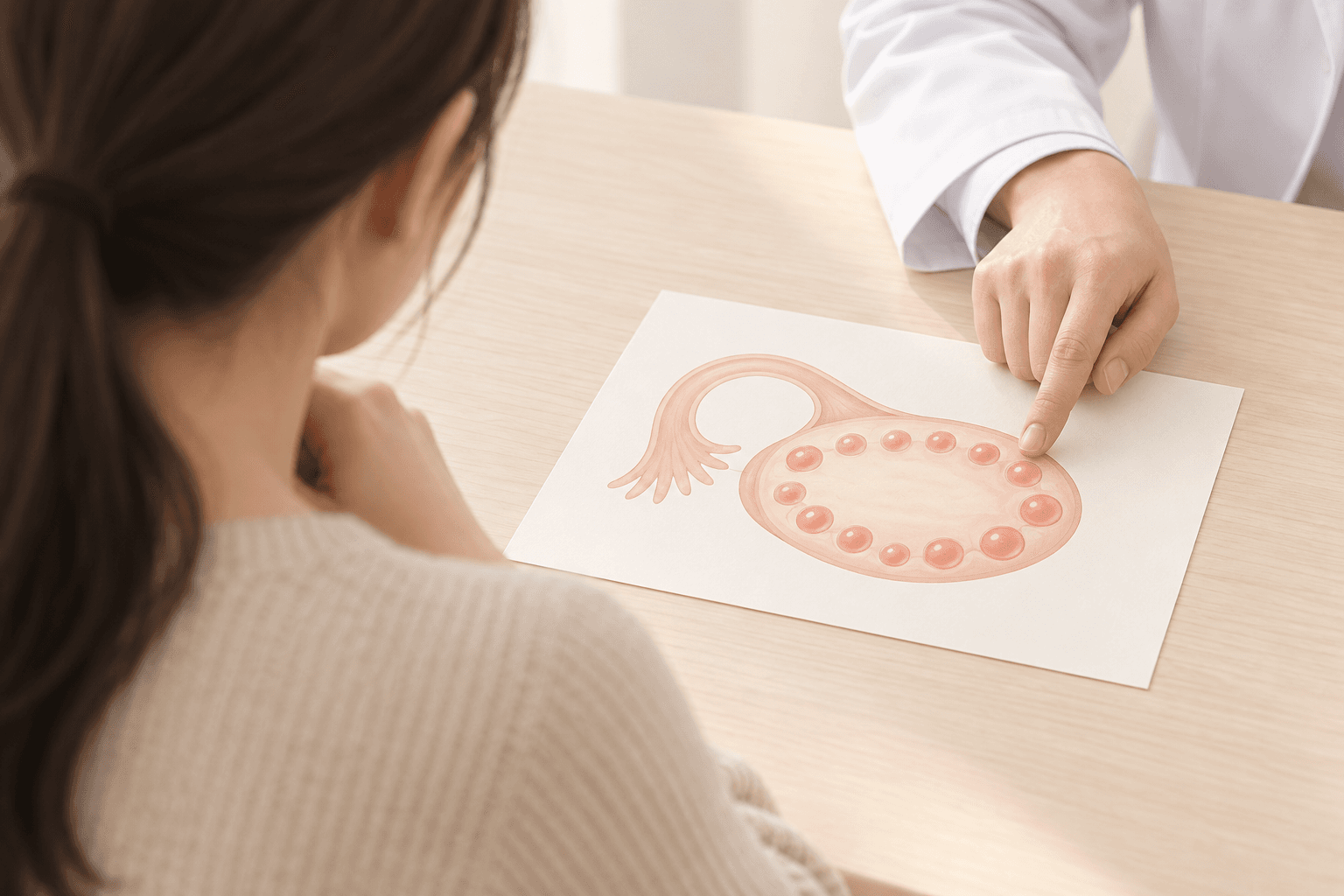
What criteria are used to diagnose polycystic ovary syndrome?
In adults, PCOS is diagnosed when at least two of the three features below are confirmed and other causes of similar changes have been ruled out. The international evidence-based guideline revised in 2023 keeps this framework and adds a blood test as one way to assess the ovarian finding.
| Feature used for diagnosis | How it is checked |
|---|---|
| Ovulation problems | Your records and history are used to see whether the gaps between periods are too long or too short and whether you have few periods in a year. Ovulation can be impaired even with regular cycles, so a blood test may be used to check when needed. |
| Signs of high male hormones | An examination looks for coarse hair on the body and face (hirsutism), acne, and thinning hair around the crown, and a blood test checks male hormone levels. |
| Polycystic-appearing ovaries | Ultrasound looks at the number of small follicles and the size of one ovary; in adults, an AMH blood test can be used instead. |
Not all three have to be present. That is why people with the same diagnosis can look quite different — for some, period changes stand out; for others, hair and skin changes are the main issue; and some have both.
Among the signs of high male hormones, an increase in coarse hair is considered a relatively meaningful clue. When there is only acne or a change in scalp hair, other causes are common, so these are judged together with the other features. If you have been regularly removing hair or having skin care, signs may be less visible on examination, so please describe how much hair you originally had.
Why are other causes checked first?
Because periods stopping or hair increasing can also be caused by conditions other than PCOS. An exclusion step is built into diagnosis so that conditions needing very different treatment are not missed.
Pregnancy is checked first. Then, according to the symptoms, factors such as thyroid function, prolactin (a hormone related to milk production), the signals between the brain and the ovaries, and hormones made by the adrenal glands are assessed. Periods that have stopped because of excessive dietary restriction or very intense exercise also need to be distinguished from PCOS.
If hair increases quickly over a short time, or changes progress rapidly — such as the voice deepening — this should not simply be dismissed as PCOS. It is best to check promptly for another condition that produces large amounts of male hormones.
What do ultrasound, AMH, and blood tests each tell you?
Each test gives information about only one of the three features and does not make the diagnosis on its own. If irregular periods and excess male hormones have already both been confirmed, an ultrasound or AMH test is not needed for diagnosis.
Ultrasound checks whether there are more small follicles in the ovary than the threshold, and whether the ovary is enlarged. Transvaginal ultrasound is the most accurate, but if you do not want it, or you have never had sexual intercourse, you can discuss other methods. Ultrasound can also show the thickness and pattern of the uterine lining. However, ovarian appearance is only one of the three features, so this finding alone does not make the diagnosis.
AMH (anti-Müllerian hormone) is a hormone made by small follicles, and in adults it can be used instead of ultrasound to assess the ovarian finding. Because levels can vary with age, weight, recent birth control pill use, and the day of testing, it is not used as a stand-alone test. To avoid overdiagnosis, it is considered unnecessary to do both an ultrasound and an AMH test. Also note that its purpose here differs from the “ovarian age” interpretation used in fertility consultations.
Male hormone blood tests are especially helpful when visible signs such as hair or acne are not clear. If you are taking birth control pills, levels can come out lower, so this is considered when interpreting the results.
Insulin resistance is known to be an important underlying feature of PCOS, but the measurement methods commonly used in clinics have limited accuracy, so it is not measured separately for diagnosis. Instead, blood sugar status is checked at diagnosis and regularly afterwards.
Why are adolescents assessed differently?
For several years after the first period, ovulation is still settling in, so irregular periods and many follicles in the ovaries are common. If adult criteria are applied as they are, normal development can be mistaken for a disease.
For adolescents, diagnosis is therefore considered when irregular periods — judged by age-appropriate criteria — occur together with excess male hormones. Ultrasound and AMH are not recommended for diagnosis in adolescents because they distinguish poorly at this age.
If only some features are present, this is regarded as a “higher-risk” state, and reassessment may be done after the body has matured. Whether to pursue a diagnosis now or wait is decided together with the young person and their parent or guardian, taking into account current discomfort and emotional burden. Recording the state before starting hormonal medication such as the pill helps later reassessment.
What else is monitored after diagnosis?
Not just periods, but also the uterine lining, metabolism, sleep, and emotional health are looked after over the long term. PCOS is less a condition that ends with short-term treatment and more one whose care goals change with each life stage.
- The uterine lining when periods are absent for a long time Without ovulation, the hormone that keeps the uterine lining in check is lacking, so the lining can keep thickening while periods are absent for a long time. The risk of endometrial hyperplasia and endometrial cancer increases, but the actual chance of developing them is itself relatively low. That is why ways to bring on a bleed regularly or protect the lining with hormonal medication are discussed. If the lining looks thick or the bleeding pattern is unusual, a tissue sample (biopsy) may be considered.
- Blood sugar and metabolism Regardless of weight, the risk of prediabetes and diabetes can be higher, so blood sugar is checked at diagnosis and regularly afterwards. Blood pressure and cholesterol are checked too.
- Sleep and mood Please mention snoring or severe daytime sleepiness. Depression and anxiety are also common, so you can talk in the clinic about mood changes or distress about your appearance.
- When planning a pregnancy During pregnancy, complications related to blood sugar and blood pressure need closer attention, so if you are preparing for pregnancy, please let us know in advance.
Weight is only one part of care, and it should not be seen as the cause of this condition or as your fault. PCOS also occurs in people with a slim build. If you would rather not discuss weight, it is fine to say so, and goals you can keep up with in eating, activity, and sleep are set together first.
How is the care plan decided?
Priorities depend on what bothers you most right now and whether you want to become pregnant. Rather than handling every symptom at once with one medication, the plan is divided by goal.
| What concerns you most | What is considered together |
|---|---|
| Irregular periods or no periods for a long time | Hormonal medications that regulate the cycle and protect the uterine lining (such as combined oral contraceptives or progestogens) are considered along with your individual risk factors. |
| Acne, excess hair, or scalp-hair changes | Hormonal treatment, skin treatment, and methods such as laser hair removal are discussed according to severity and the result you want. For excess-hair changes, it can take several months to judge the effect. |
| Blood sugar and metabolic risk | Based on lifestyle management, a medication that helps insulin work may also be considered if needed. |
| Wanting to become pregnant | Along with whether you ovulate, other factors such as the fallopian tubes and uterus and your partner’s tests are assessed, and if needed, care continues with treatment to help ovulation or with specialist fertility care. |
Hormonal medications are used after checking your individual health, such as your risk of blood clots, and common side effects and precautions differ from drug to drug. Some medications that reduce hair can affect a fetus during pregnancy, so reliable contraception is needed. For this reason, whenever pregnancy plans arise or change, you should discuss again whether your current medication is still suitable.
Even if symptoms improve with treatment, they may return when the medication stops, and when goals change, the plan changes too. Rather than treating it once and being done, think of it as a process of regularly reviewing your periods, skin, metabolism, and pregnancy plans and adjusting as you go.
You can also review the diagnostic process and care goals in LILEAP’s Polycystic Ovary Syndrome care guide. The order in which things are checked when you bring your period records to a visit is covered in the column Order of evaluation for menstrual-cycle changes.