
Maybe a condom broke, maybe you had sex with someone new and it is still weighing on you, or maybe a partner has told you to get tested. When you are worried, you may want to be tested as soon as tomorrow. With tests for sexually transmitted infections, though, what a result means depends less on "how soon" and more on "when" you take the test. Thinking about getting tested is a natural way of looking after your body, not a process of deciding whose fault it is.
Do I need an STI test even without symptoms?
There are situations where testing is needed even if you feel nothing unusual. Common infections such as chlamydia often cause no symptoms, so, without you knowing, they can develop into pelvic inflammatory disease or be passed to a partner.
- When you had sex without a condom, or a condom broke or slipped off during sex
- When you have a new partner or more than one partner
- When a partner has been diagnosed with a sexually transmitted infection or has told you they have symptoms
- When you are planning a pregnancy or are in early pregnancy
- When you are sexually active and want to check regularly
How often to test regularly depends on your age and lifestyle. The US Centers for Disease Control and Prevention (CDC) recommends that sexually active women under 25 be tested for chlamydia and gonorrhea every year, and advises that women 25 and older may also need yearly testing if they have a new partner, multiple partners, or a partner with an infection. Which tests you need are decided together at your appointment after hearing about your situation.
If I have symptoms, should I wait for the right time to test?
If you have symptoms, do not wait—see a doctor right away. The testing times explained below are about "when a result can be trusted" if you have no symptoms. When you have symptoms, an examination and any tests needed at that visit come first.
- Discharge or odor that is not normal for you, or yellow or green discharge
- Burning or stinging when you urinate
- Pain in the lower abdomen
- Bleeding after sex or between periods
- Blisters, sores, wart-like bumps, itching or a rash on or around the genitals or anus
In particular, the first sore of syphilis is painless and easy to miss, and if it forms inside the vagina or anus, it can be hard to see. Even if symptoms appear and then go away on their own, the infection may still be there, so do not put off seeing a doctor because they have gone.
Why might a test taken right after sex not be accurate?
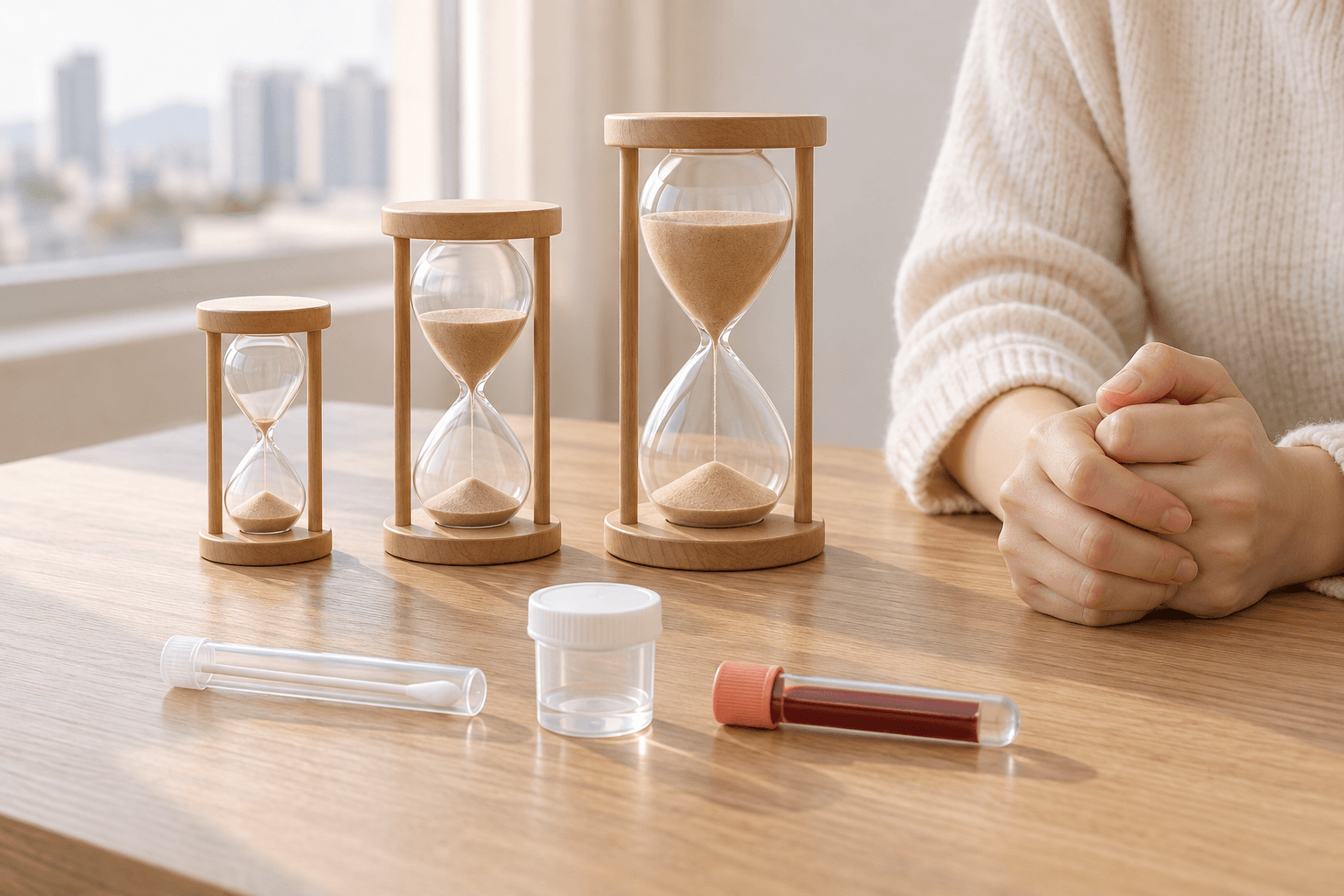
Because even if you have been infected, it takes time for enough germs or antibodies to build up to be detected by a test. This time is called the "window period," and if you test within it, the result can be negative even when an infection is present. The window period differs by type of infection and test method.
| Infection | Approximate time when results can be trusted | Also good to know |
|---|---|---|
| Chlamydia and gonorrhea | About 2 weeks after sex | Guidance from UK sexual health organizations. Checked with a vaginal fluid sample or urine; if you have symptoms, do not wait 2 weeks. |
| HIV | Depends on the test method: antigen/antibody test using blood from a vein, 18–45 days; rapid finger-stick test, 18–90 days; antibody test, 23–90 days | CDC criteria. Most rapid tests and self-tests are antibody tests. |
| Syphilis | 12 weeks after sex | Criteria used by a testing service that works with the UK NHS. The first symptoms may appear 3 weeks or more after infection. |
The numbers in the table vary somewhat by organization and test method, and they are not a promise that "testing on this date settles it." The UK NHS advises that because STIs can take up to 7 weeks to show up on a test, it is better to wait 7 weeks before testing if you have no symptoms. If you are too worried to wait that long, testing is sometimes split: an initial check at around 2 weeks, then blood tests repeated at the appropriate time. How to split it is decided together at your appointment based on the exposure date.
What should I write down before testing?
Jotting down dates and circumstances helps a great deal in deciding which tests you need and when. If something is hard to say out loud, it is fine to simply show your notes.
- The date of the sex you are worried about If it happened more than once, write down both the first and last dates. Testing times are calculated from the last exposure.
- Areas of contact Let us know if there was oral or anal contact as well as vaginal sex. Separate throat or anal samples may be needed.
- Condoms and contraception Note whether a condom was used from start to finish, whether it broke or slipped off, and whether you use another method of contraception. This also helps in assessing the chance of pregnancy.
- Symptoms and when they started Write down when discharge, pain, bleeding or skin changes began and how they are now.
- Previous tests and treatment Bring the date of your last test, which tests you had and the results, and, if you were treated, the names of the medicines and how long you took them.
- Your recent period and current medicines Tell us the first day of your last period, any medicines you are taking and any drug allergies.
If the sex has also left you worried about pregnancy, timing matters for emergency contraception, separately from STI testing. Check our contraception information and contact a medical professional as soon as possible.
Should I tell my partner, and should we avoid sex during treatment?
If an infection is confirmed, your current and recent partners also need testing and treatment, and as a rule both of you should avoid sex until both of you have finished treatment. If only one person is treated, you can pass the infection back and forth and it can keep coming back.
When it is safe to have sex again depends on the infection. The UK NHS advises avoiding sex, including oral sex, until you and your partner have finished treatment and tests show the infection is gone for chlamydia and gonorrhea, and until 2 weeks after you have both finished treatment for syphilis. Take all of your prescribed medicine even if your symptoms go away.
A result alone cannot tell you exactly when or from whom an infection came. Because an infection can go without symptoms for a long time, it may have started longer ago than you think. When you talk with a partner, starting with "let's both get checked and treated" rather than assigning blame can make the conversation much easier.
When do I need to act right away?
If you are worried about HIV exposure and fewer than 72 hours have passed, do not wait for a testing window—contact a medical facility right away. Post-exposure prophylaxis (PEP) must be started within 72 hours, and the sooner the better.
Test items, samples and plans after you receive your results are summarized in LILEAP's STI screening information. If you are wondering whether a change in discharge is due to an infection or vaginitis, see also our vaginitis care information and what to look at when your discharge changes.