
“It came late this month—is it all right to wait a little longer?” After the expected date passes, you may keep looking at the calendar. At that point, look at how many days late it is and also look back at what your periods are usually like.
A record is not a score sheet for judging on your own whether you are healthy. It is a note for describing specifically, in the exam room, what change has occurred.
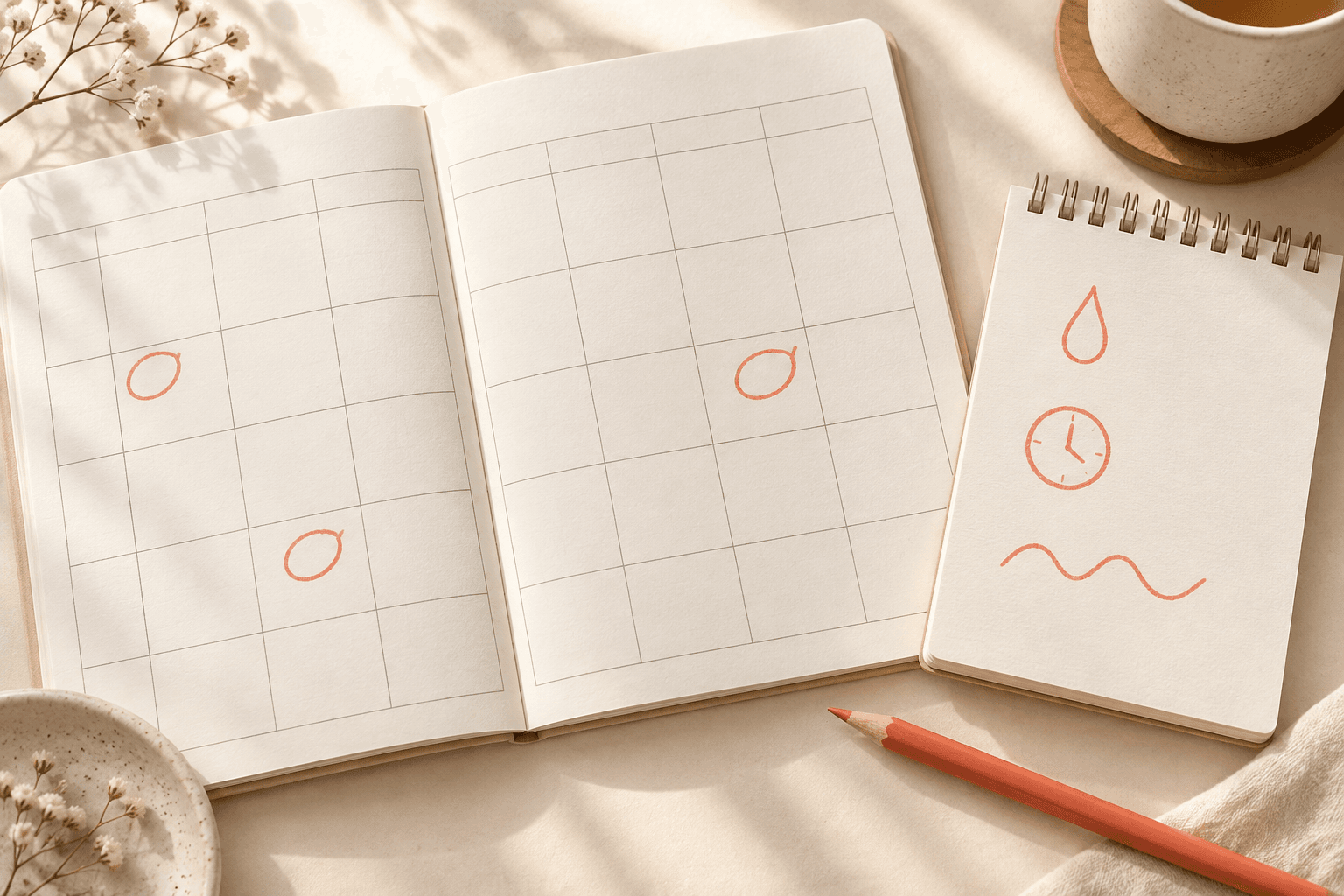
How are the menstrual cycle and the length of a period different?
The cycle is the interval between start dates, and the length is the number of days bleeding continued in one period.
For example, if a period started on September 2 and ended on the 6th, and the next period started on September 30, they are distinguished as follows. The example is only to explain the calculation. It is not a standard for deciding what is normal.
| Item | In this example |
|---|---|
| Menstrual cycle | September 2 → September 30, a 28-day interval |
| Period length | September 2–6, bleeding for 5 days |
Looking only at the start date can miss a change in which bleeding lasts longer. Please also keep the date it ended. If a small amount of blood appeared between periods, it helps to write that day’s pattern separately from your usual period.
What is helpful to write on the calendar?
Rather than writing at length, leave the date, bleeding, pain, and recent changes as separate notes. A paper calendar or the notes app you usually use is enough.
- When it started and ended Write the start date, the day it ended, and any day there was separate bleeding between periods.
- How the bleeding changed Note whether it was lighter or heavier than usual, how often you changed menstrual products, and whether it leaked onto clothing or there were clots.
- Where it bothered you, and how much Note the place and timing of pain, whether sleep or daily life was affected, and the name of any medicine you took.
- Whether anything has changed recently At the visit, also talk about changes in weight, amount of exercise, or stress, a change in contraception or medicines, and the possibility of pregnancy.
Items you do not remember can be left blank. You do not need to delay a visit in order to finish a perfect record.
Does a change in the cycle mean an illness has developed?
The fact that a change occurred does not by itself settle the cause. Age, changes in daily life, the possibility of pregnancy, and the contraceptive method being used are looked at together.
Major stress, a rapid change in weight, or excessive exercise can affect periods. The pattern can also change when hormonal contraception is started or switched, while cycles are settling after menarche, and during the transition toward menopause.
Do not set aside every change by saying, “I have been tired lately, so that must be why.” Some causes need to be checked, including thyroid problems, and the tests that are needed are decided from the changed pattern and the symptoms that come with it. Please check medicines you use at a visit rather than changing them on your own.
If pregnancy is possible, do not explain a late period only as a change in daily life. A test and counseling to check whether you are pregnant should be considered.
What changes mean you should be seen?
Counseling is recommended when the cycle becomes irregular, your usual pattern has changed, or there is bleeding between periods. Whether bleeding or pain interferes with daily life is also an important guide.
- Bleeding that is different from before keeps recurring, or periods last longer than usual.
- Changing menstrual products becomes noticeably more frequent, or bleeding makes it hard to go out or to sleep.
- Blood appears between periods, or pain is new and getting worse.
In counseling, the record and history are reviewed before judging whether tests are needed. A record alone is not used to diagnose a condition, and the same tests or treatment are not decided for everyone.