
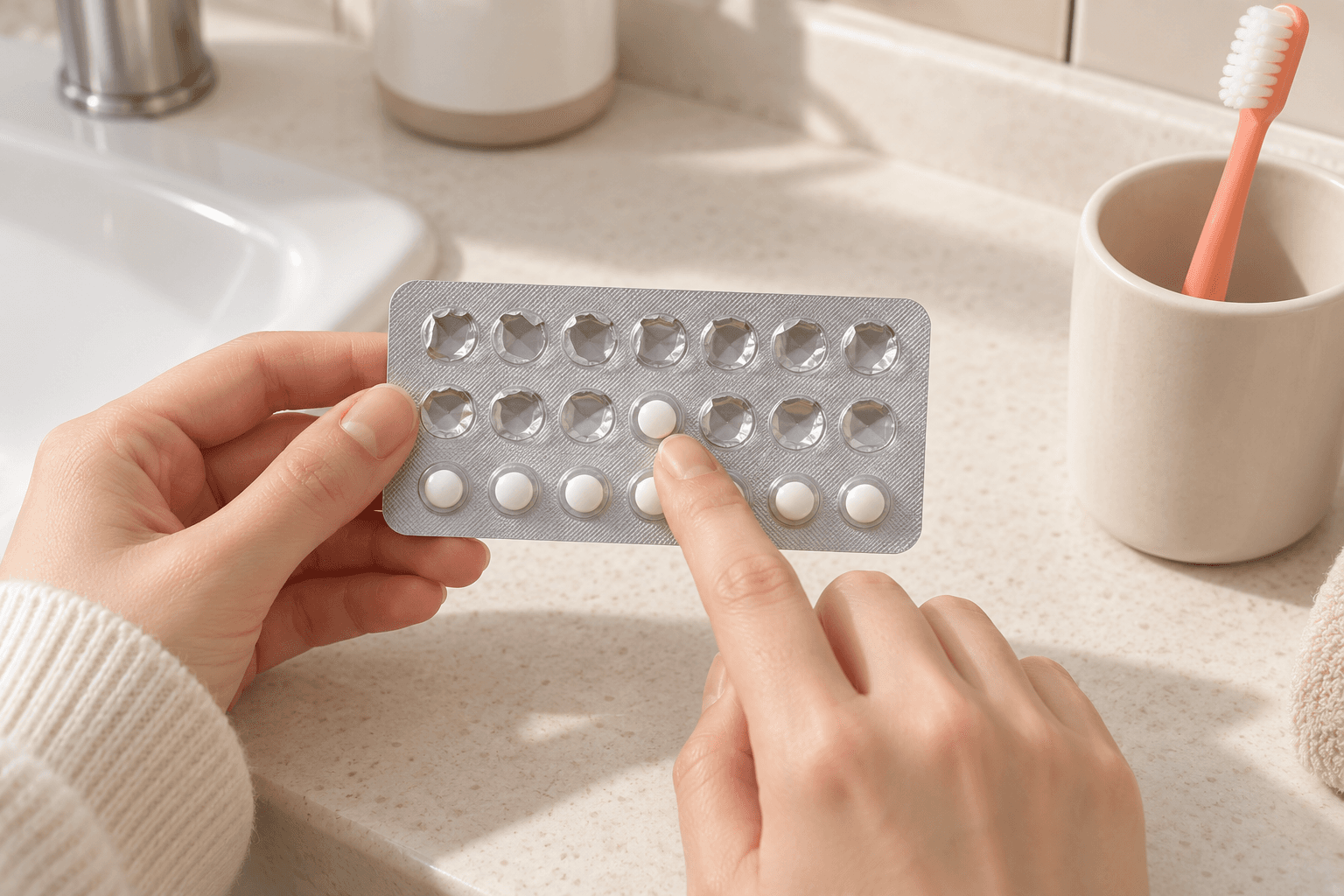
Sometimes you open your pill pack in the morning and see that yesterday’s pill is still there. Because it is a pill you take at the same time every day, missing one now and then is more common than you might think. What to do next usually comes down to two things: how many pills you missed, and where in the pack you missed them. This article is based on the commonly used combined oral contraceptive pill (a pill that contains both estrogen and progestin), specifically products taken for 21 days followed by a 7-day break.
What should I do first when I remember?
As soon as you remember, take 1 pill — the most recently missed one — and take the following pills at your usual time. It is fine if this overlaps with that day’s pill and you take 2 pills in one day. Even if you missed several pills, do not take them all at once; skip the other missed pills.
- Keep taking the pack in its original order until the end. Do not start a new pack just because you missed a pill.
- If you missed a pill without hormones (a placebo pill), such as the last few pills of a 28-pill pack, your protection is not affected. Check the leaflet to see which pills are placebo pills.
- Writing down the position of the pill you missed, the date and time you last took a pill, and the date you recently had sex will make the next decisions easier.
How is missing 1 pill different from missing 2 or more?
If 1 pill is simply late, protection is usually maintained, but if you missed 2 or more in a row, protection may be reduced, so you need additional contraception for 7 days. “How late” is counted from the time you should have taken the pill.
| Situation | Protection | What to do |
|---|---|---|
| 1 pill, less than 48 hours after the usual time | Usually maintained | Take 1 pill as soon as you remember, then continue at your usual time. Additional contraception is usually not needed |
| 2 or more in a row, 48 hours or more | May be reduced | Take the most recent 1 pill and keep going. Use condoms as well or avoid sex until you have taken the pill for 7 days in a row |
This table summarizes the guidance of the UK Faculty of Sexual and Reproductive Healthcare (FSRH) and the US Centers for Disease Control and Prevention (CDC). The figure of 7 days comes from the view that the pill needs to be taken for a week in a row to reliably suppress ovulation.
Why do I need to be more careful if I miss pills in the first or last week?
Because these weeks sit right next to the 7-day pill-free break, each missed day makes the time without hormones longer. If you go more than 7 days without the pill, ovulation can occur. That is why the same 2 missed pills call for different steps depending on where in the pack you missed them.
- First week (pills 1~7): This comes right after the pill-free break, so it is the time to be most careful. If you missed 2 or more, use additional contraception for 7 days, and if you had sex without contraception during the break or the first week, check whether you need emergency contraception counseling. Starting a new pack late after the break is treated the same way.
- Second week (pills 8~14): If you took every pill in the 7 days before, the risk of pregnancy is relatively low. If you missed 2 or more, use additional contraception for 7 days.
- Last week (pills 15~21): If you missed 2 or more, finish this pack and start a new one straight away without a break, and use additional contraception for 7 days. In this case you may not have a period-like bleed until you finish the next pack, or you may have some spotting in between.
Products taken for 24 days with a 4-day break, 28-pill products that include placebo pills, and some products with a different composition use different week divisions and rules. Progestin-only pills follow completely different rules: for some types, a pill counts as missed if it is just 3 hours late. If you are not sure which kind you take, bring the pack and the leaflet and ask a pharmacist or clinician.
When do I need emergency contraception advice?
If you missed 2 or more pills in the first week and had sex without contraception around that time, seek emergency contraception advice promptly. The US CDC advises considering emergency contraception if pills were missed in the first week and you had sex within the last 5 days.
- When you missed 2 or more pills in the first week and had sex without contraception during the pill-free break or the first week
- When your pill-free break stretched to 8 days or more so you started the new pack late, and you had sex without contraception during that time or just after
- When you could not take the pill for more than a week in a row: plan again as if you were starting for the first time, and a pregnancy check may be needed first
Emergency contraception works best the sooner it is used. While you are still taking the pill, some types of emergency contraceptive pill may be affected, so you and your clinician decide together which method suits you and when to continue your pill. The basics are summarized in our Contraception information.
If you do not have a period-like bleed during your next pill-free break after taking these steps, you need to check for pregnancy. For when to use a pregnancy test, see what to check when your period is late but the test shows one line.
Does vomiting or diarrhea count as a missed pill?
If you vomit shortly after taking your pill, it may not have been fully absorbed, so take 1 more pill. The UK National Health Service (NHS) advises that if you vomit within 3 hours of taking the pill, you should take 1 more pill straight away and take the next one at the usual time. Some leaflets in Korea use 3~4 hours instead. Taking the extra pill from a spare pack lets you keep the original order.
- If vomiting continues and you cannot keep the pill down, treat it as a missed pill and use condoms as well until you have taken the pill again for 7 days in a row.
- If diarrhea lasts more than 24 hours, keep taking your pill as normal, but use additional contraception for 7 days after the diarrhea stops.
- If this happened in the last week, check how to go straight on to a new pack without a break.
Other medicines can also affect how well the pill works. Typical examples are medicines for tuberculosis, epilepsy or HIV, some antifungal medicines, and herbal products such as St John’s wort. Whenever you see another doctor or buy medicine, be sure to mention that you take the pill.
How can I avoid forgetting again?
Linking the pill to something you do every day without fail is a practical approach. Taking it as part of the same daily routine helps you remember it better than trying to hit an exact time.
- Pair it with a daily habit: Keep the pack right next to something you never skip, such as brushing your teeth or washing your face before bed.
- Set a repeating alarm: Set a daily repeating alarm on your phone and make a habit of turning it off only after taking the pill.
- Check the pack: Looking at the pockets marked with days of the week to see whether today’s is empty stops you wondering whether you took it.
- Mark the end of the break: Writing the date you start the next pack on a calendar in advance helps you avoid starting it late.
- Spares and travel: Keep a spare pack in your bag, and when abroad, make sure the gap since your last pill does not grow, whatever the time difference.
If you still forget often, it may be time to change the method rather than blame yourself. You can also discuss other methods that fit your life and do not need to be taken every day, such as an intrauterine device or Implanon.
What are the benefits of consultation before starting the pill?
You can decide in advance when to start so that it works right away, whether the pill suits your health, and what to do if you forget to take it. Some leaflets in Korea recommend starting on the first day of your period, and using condoms as well for the first 7 days if you start later. The UK NHS, on the other hand, says you are protected straight away if you start within 5 days of your period starting — so the rules for when to start also differ between products and organizations.
There may also be situations where the combined oral contraceptive pill is not suitable. Be sure to tell us before starting if you are 35 or older and smoke, if you have ever had a blood clot or a family member had one at a young age, if you have migraines with warning signs (aura), or if you have high blood pressure or heart disease. In the first few months you may have some discomfort, such as bleeding between periods, nausea, headaches or breast pain, and if it continues beyond three months, you can discuss changing to a different pill.