
When you get your report a few days after testing, it can be a list of unfamiliar English abbreviations and words like "detected" and "reactive." You may feel relieved that everything is negative and then be told to test again, or be puzzled that a single syphilis test has two lines of results. Following when to get tested for STIs after sex, this time we look at what each test checks, how to read the results, and what to do next.
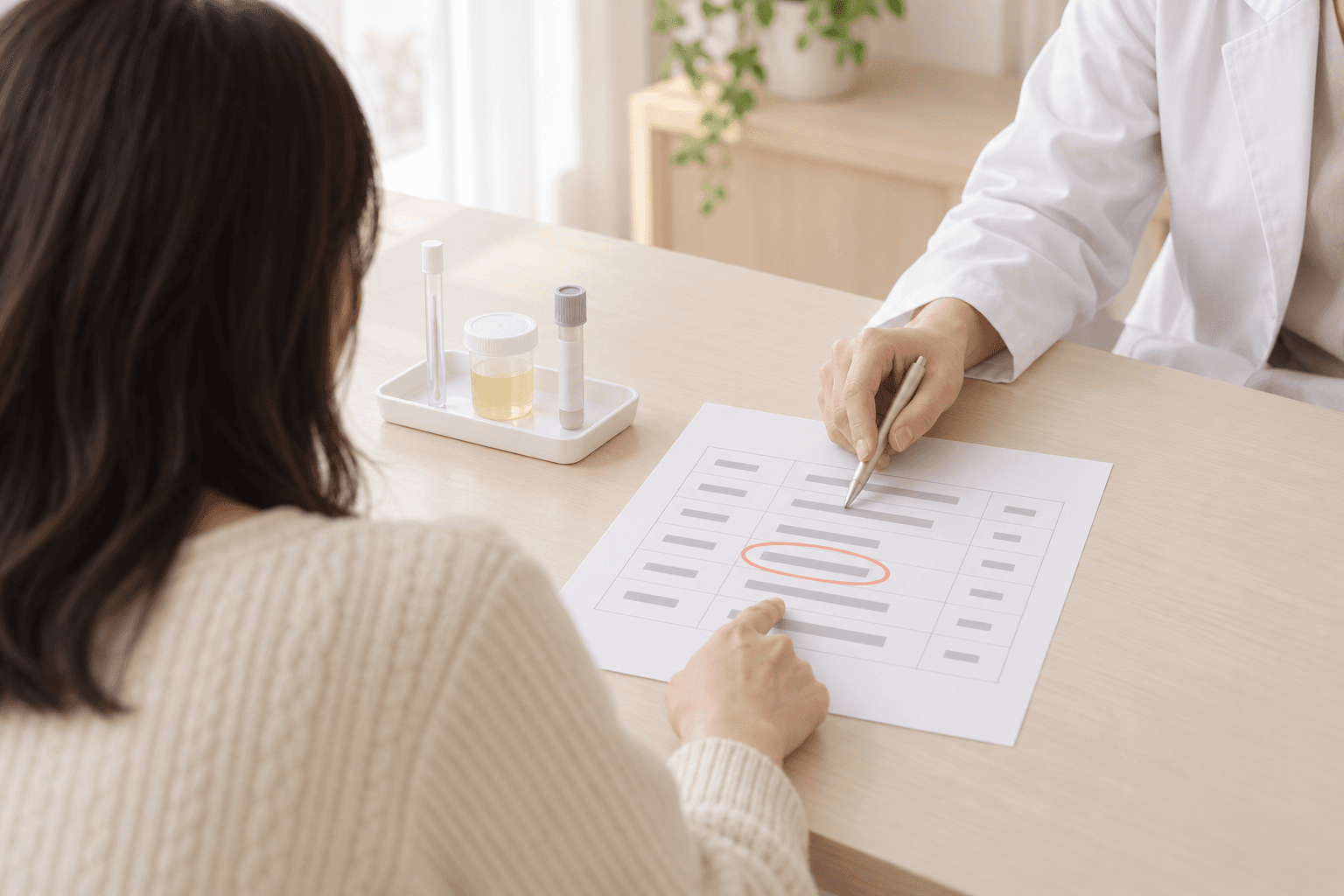
What kinds of STI tests are there?
The sample and the test method depend on the infection being looked for. Infections found by detecting the germ itself, such as bacteria, are tested with a swab or urine, infections confirmed by the antibodies the body makes are tested with blood, and if there is a blister or sore, that spot is tested.
| Test method | Sample | Main infections checked | Good to know |
|---|---|---|---|
| PCR test (genetic amplification test) | Vaginal swab, urine. Throat or anus depending on the type of contact | Chlamydia, gonorrhea, trichomoniasis, Mycoplasma genitalium, etc. | Looks for the germ's genetic material. A vaginal or urine sample cannot show an infection in the throat or anus. |
| Blood test | Blood drawn from a vein in the arm | Syphilis, HIV, etc. | Looks for antibodies made in response to infection (and antigens too for HIV), so it takes time for them to appear. |
| Lesion test | Fluid taken from a blister or sore | Herpes, the early sore of syphilis | Can be done when a lesion is present. |
| Examination | Visual check of the genital and anal area | Genital warts (condyloma), etc. | Judged by shape and location, with other tests added if needed. |
Bundles with names like an "N-item test" are usually PCR tests that check for several germs at once from a single swab or urine sample. Even with many items, infections confirmed by blood, such as syphilis and HIV, need to be tested separately. The germs in a bundle do not all carry the same weight, either. Some germs are not recommended for testing when there are no symptoms, and not everything detected is treated, so it is best to have the meaning of each item explained.
How do I read PCR test results?
The report lists each item as "detected" or "not detected," or as positive or negative. Detected means the germ's genetic material was found in the sample, and not detected means it was not found in this sample.
A PCR test is sensitive enough to find even small amounts of a germ, but there are limits to keep in mind when reading it.
- Timing: If you test before the germ has had time to multiply, such as right after sex, the result can be "not detected" even when an infection is present.
- Sample site: A vaginal or urine sample cannot stand in for checking the throat or anus. If there was oral or anal contact, a sample from that site may be needed separately.
- Right after treatment: If a PCR test is repeated less than 4 weeks after finishing chlamydia treatment, genetic material from germs that are already dead can be picked up and give a positive result. That is why tests to confirm treatment are timed.
Why does a syphilis blood test give two results?
Because syphilis is judged by looking at two different kinds of antibody tests together. One is used for screening and for following treatment (RPR, VDRL), and the other is a confirmatory test that looks for antibodies specific to the syphilis bacterium (TPHA, TP-PA, FTA-ABS, etc.). Some labs run the confirmatory test first.
| RPR·VDRL | Specific antibody test | What it may mean |
|---|---|---|
| Negative | Negative | No evidence of syphilis infection. If it was right after an exposure, though, it is checked again after some time. |
| Positive | Negative | Possibly a false positive, which is positive without syphilis. This can happen during pregnancy, with autoimmune diseases or other infections, after vaccination, or at an older age. |
| Positive | Positive | May be syphilis that needs treatment or syphilis that was treated in the past. Previous treatment history and the level (titer) are looked at together. |
| Negative | Positive | May be syphilis treated in the past, a very early infection, or rarely a false positive, so treatment history is checked and another specific antibody test is added if needed. |
Specific antibodies usually stay positive for life, even after successful treatment. So treatment is followed with the titer of the RPR or VDRL test, a number showing how far the blood can be diluted and still react, and the care team checks whether this number falls 4-fold or more after treatment. If you have been treated before, tell the clinic about it and your earlier numbers when you are tested elsewhere. The same result can mean different things depending on your history.
If an HIV blood test comes back "reactive" or positive, the diagnosis is not made from that result alone; a confirmatory test follows. HIV infection is diagnosed when the confirmatory test is also positive.
Are there times to test again even with a negative result?
Yes. A negative result means "not found for the items tested, at the sites tested, at the time tested." If any of the following applies, do not just close the matter; talk about whether to retest.
- When the time from exposure to testing was shorter than the window period for that infection. You can find when results become reliable for each infection in our column on STI testing timing.
- When some items were not tested. For example, if you only had a PCR test on a swab, syphilis and HIV have not been checked yet.
- When there was oral or anal contact but only a vaginal or urine sample was tested
- When symptoms such as changes in discharge, pain or blisters continue despite a negative result
- When there was a new exposure after the test
If symptoms continue but STI tests are negative, there may be another cause, such as vaginitis. If you also have changes in discharge, see our vaginitis care information as well.
What should I do if the result is positive?
If the result is positive, you start treatment, your partner also gets tested and treated, and you set a time to test again after treatment. As a rule, avoid sex during treatment; when it is okay to start again depends on the infection, so check during your visit.
- Finish the treatment as prescribed Do not cut down or stop the medicine on your own, even if symptoms improve first. Tell your care team if you missed doses or vomited after taking the medicine.
- Partner testing and treatment Recent partners may also need testing and treatment, even without symptoms. If only one person is treated, you can pass the infection back and forth.
- Schedule a retest after treatment The U.S. Centers for Disease Control and Prevention (CDC) recommends that people treated for chlamydia, gonorrhea or trichomoniasis be tested again about 3 months later. This is because reinfection is common, more often than treatment failure, and it applies even if you believe your partner was treated.
- Ask whether a test of cure is needed A test to confirm right away that treatment worked is not needed for everyone. It is done separately during pregnancy, when gonorrhea was found in the throat, or when symptoms remain or the medicine was not taken properly.
The report alone cannot tell when or from whom the infection came. The time without symptoms can be long, so the infection may have started earlier than you think.
What should I ask when I get my results?
When reading results, checking "what was tested, where and when" together makes the next plan clear. Bring your report and ask the following.
- Items tested: Which infections were included in this test, and which were not?
- Sample site: Where was the sample taken from? Do I need a throat or anal sample?
- Timing: Counting from my last exposure, was I tested at a time when this result can be trusted?
- Next test: If a retest or a confirmation test after treatment is needed, when should it be?
- Partner: Who should be tested, and with which tests? When can we have sex again?
How test items and samples are chosen, and the plan after you receive results, are summarized in LILEAP's STI screening information. If you are wondering about an HPV test result from cervical cancer screening, also read the difference between a cervical cytology test and an HPV test.