
There are moments when it is hard to be sure contraception worked: a condom broke or slipped off, you realized only later that you had missed your pill for a few days, or you cannot clearly remember whether you used contraception at all. At times like these, the first thing to do is not to blame yourself but to check the date and time of the sex. The morning-after pill becomes less effective as time passes, so how many hours have gone by shapes the choices that follow.
Can I buy the morning-after pill straight from a pharmacy?
No. In Korea the morning-after pill is a prescription-only medicine, so you need to see a doctor and get a prescription before a pharmacy can sell it to you. In the approval information of the Ministry of Food and Drug Safety, both the levonorgestrel pill and the ulipristal pill are classified as prescription-only medicines, and although the 2026 parliamentary audit discussed making prescriptions easier to get, a prescription is still required. Be careful not to lose time thinking you can buy it straight from a pharmacy as you can in some countries.
You need to be seen in person to get the prescription. At the appointment, you will roughly be asked about:
- The date and time of the sex you are worried about, and whether you have had sex again since
- The start date of your last period and your usual cycle
- The contraception you were using and why you are worried it failed
- Any medicines you take, whether you are breastfeeding, and whether you have taken the morning-after pill before
If it is hard to say out loud, simply bringing a note of the date and time is enough. With this information, we decide together which pill suits you, or whether another method would be better than a pill.
How long after sex can I take it?
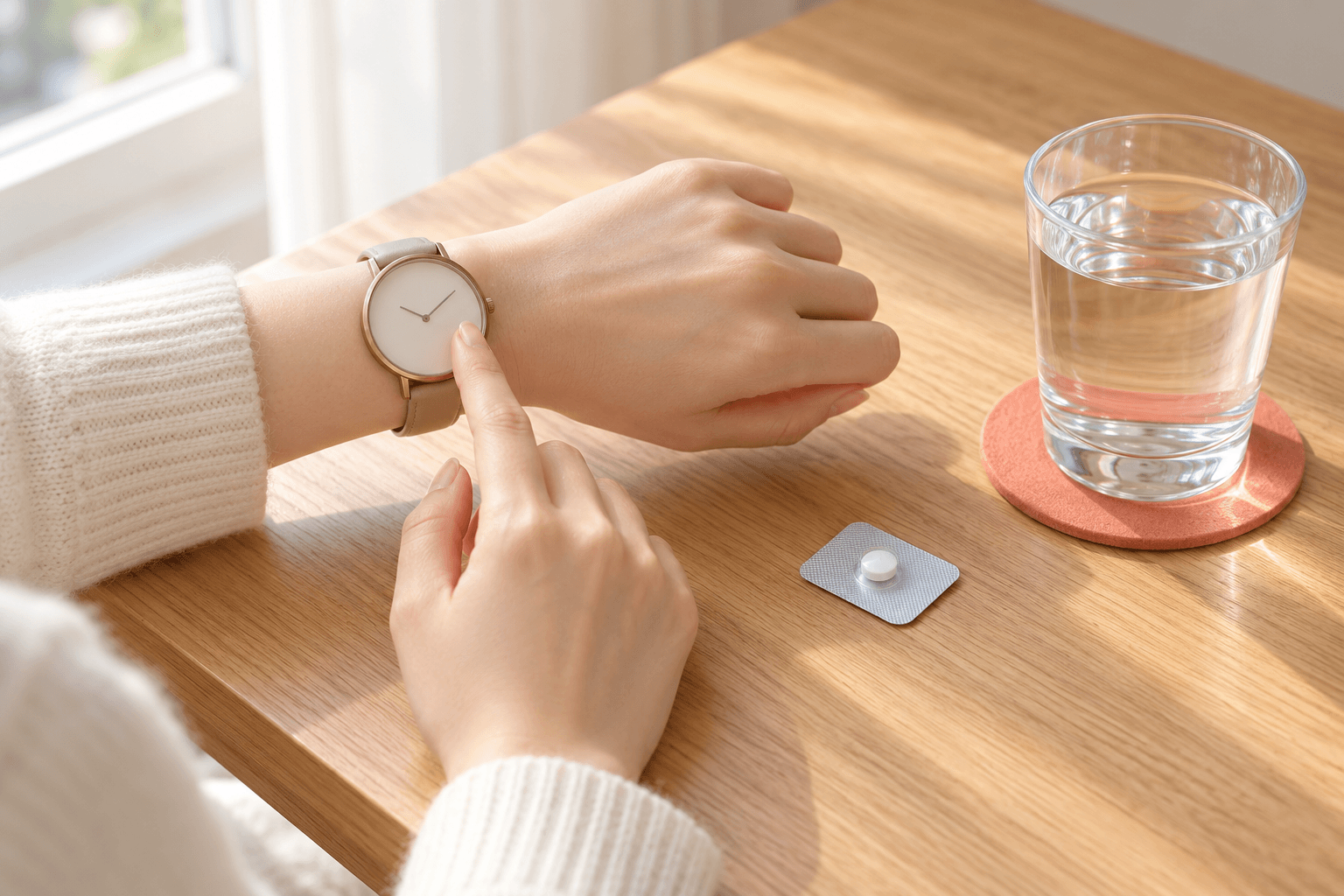
Levonorgestrel pills are approved for use within 72 hours after sex, and ulipristal pills within 120 hours. But with either pill there is no reason to wait until the deadline; the rule is to take it as soon as possible.
The morning-after pill mainly prevents pregnancy by delaying or stopping ovulation. Sperm can survive in the body for several days, and if ovulation happens in the meantime, there is less the pill can prevent. As time goes on, ovulation is more likely to be close, so even with the same pill, taking it earlier works better. The Korean product information for levonorgestrel also says to take it “as soon as possible (within 12 hours recommended).”
What is the difference between the two pills?
The emergency contraceptive pills used in Korea contain one of two ingredients, levonorgestrel or ulipristal, and the biggest differences are how long after sex you can take them and how they interact with other hormonal medicines. Which one suits you is decided at your appointment, based on how much time has passed, your menstrual cycle and the medicines you take.
| Category | Levonorgestrel | Ulipristal |
|---|---|---|
| Approved time window | Within 72 hours (3 days) after sex | Within 120 hours (5 days) after sex |
| How to take | One 1.5mg tablet | One 30mg tablet |
| Starting the contraceptive pill afterward | Can start right away (use condoms as well for the first 7 days) | Start after 5 days have passed since taking it |
| If breastfeeding | Advised to pause breastfeeding for at least 8 hours after taking it | Advised to pause breastfeeding for one week after taking it |
| Also worth knowing | Limited reports suggest it may be less effective at higher body weight or body mass index | May be less effective if taken with stomach medicines that reduce stomach acid |
With either pill, some medicines, such as those for tuberculosis, epilepsy or HIV, or St John’s wort, can make it less effective, so please tell us about every medicine you take. WHO explains that between 72–120 hours, ulipristal is more effective than other emergency contraceptive pills. Still, taking either pill does not guarantee that pregnancy is prevented. The UK’s NHS cites research showing that out of every 100 people who take an emergency contraceptive pill, around 1–2 get pregnant.
Besides pills, there is also the option of having a copper intrauterine device (IUD) fitted within 5 days after sex. WHO and the NHS describe this as the most effective method of emergency contraception, and once it is fitted, you can keep using it as long-term contraception. However, it must be inserted by a clinician and may not be suitable in some cases, such as when an infection is suspected, so if you would like this option, first check at your appointment whether it is possible.
What if I throw up or have some bleeding after taking it?
If you vomit within 3 hours of taking the pill, it may not have been fully absorbed, so contact the clinic that prescribed it or a pharmacy right away to check whether you need to take another one. The Korean product information for both ingredients says to take one more tablet if you vomit within 3 hours of taking it.
Other changes that may follow are usually temporary.
- Common symptoms: nausea, headache, dizziness, tiredness, breast tenderness, and lower abdominal pain like period cramps
- Light bleeding: you may have a little bleeding or spotting before your next period. Do not take this bleeding as your period and assume all is well.
- Changes to your next period: it usually comes around the expected date, but it may come a few days early or late.
When should I take a pregnancy test?
Take a pregnancy test if your next period is close to a week later than expected, or if instead of a period you have only light bleeding that is different from usual. The Korean product information advises a pregnancy test if there is no period 5 days after the expected date for levonorgestrel, and 7 days after for ulipristal. If your cycle is irregular and it is hard to guess when your period is due, check, as the Korea Population, Health and Welfare Association advises, if your period has not started 3 weeks after taking the pill.
A test taken right after sex or a few days later cannot show a pregnancy from that sex. If the result shows one line but your period still has not come and you are unsure, see our article When your period hasn’t come but the pregnancy test shows one line for when to test again.
The morning-after pill does not prevent sexually transmitted infections. If you are worried about infection from the sex, see our article on when to get tested for STIs after sex for testing times.
Can I keep using the morning-after pill as my contraception?
The morning-after pill is for emergencies and does not replace regular contraception. It is less effective than contraception used every time, and the Korean product information does not recommend taking it more than once in the same menstrual cycle. Taking it often can disrupt your cycle and lead to more frequent bleeding.
Sex after taking it also needs separate thought. The morning-after pill works only on sex that has already happened, and it does not protect you during sex after you take it. Until your next period starts, it is safer to use condoms as well. If you took ulipristal, start the contraceptive pill or another hormonal method only after 5 days have passed since taking it, so that the two do not reduce each other’s effect.
Using this experience as a chance to settle on a method that suits you can help you avoid going through the same worry again. There are several options, such as a pill taken every day, condoms used during sex, or methods that last a long time, like an IUD or Implanon. The features of each method and what to check during consultation are in our Contraception information, and our overall consultation on contraception and pregnancy is in our Contraception & Abortion Care information.