
Period pain that comes every month is so familiar that it is easy to shrug it off with “this is just how it is.” But if pain that stayed much the same for years has changed recently, or your pelvis still feels heavy and sore after your period has ended, the picture is a little different.
In the previous article, we introduced a way of writing down when, where and how it hurts. Today we will explain, step by step, how those notes are used at your appointment to tell the causes apart, and what tests can and cannot show.
How is period pain divided into types?
Period pain is divided into “primary dysmenorrhea,” which has no underlying condition, and “secondary dysmenorrhea,” which is caused by another condition inside the pelvis. More than half of people who menstruate are known to have some degree of period pain, and in many cases it is primary dysmenorrhea.
Primary dysmenorrhea happens when, at the start of a period, the lining of the uterus produces large amounts of substances called prostaglandins, which make the uterus contract strongly. These substances peak around the first day of the period and decrease as it continues, so the pain is often worst for the first day or two and then gradually settles.
Secondary dysmenorrhea is when there is a separate cause of pain in the uterus, the ovaries or elsewhere in the pelvis. Because the underlying condition takes time to develop, it tends to appear or worsen several years after the first period rather than right after it.
| What to look at | Typical of primary dysmenorrhea | Typical of secondary dysmenorrhea |
|---|---|---|
| When it first started | Within 1–2 years of the first period | Many years after the first period |
| When it hurts | From just before or around the start of the period, for 2–3 days | Starting several days before the period, or continuing after it ends |
| Change over time | May ease with age or after childbirth | Gets worse or lasts longer year by year |
| Response to painkillers | Usually controlled when taken appropriately | May not settle well with painkillers |
This table shows tendencies only, and the line between the two is not sharp. Pain that looks like primary dysmenorrhea can still have an underlying condition, and both can be present at the same time. In the end, primary dysmenorrhea is a judgment made when the examination and tests show no other cause.
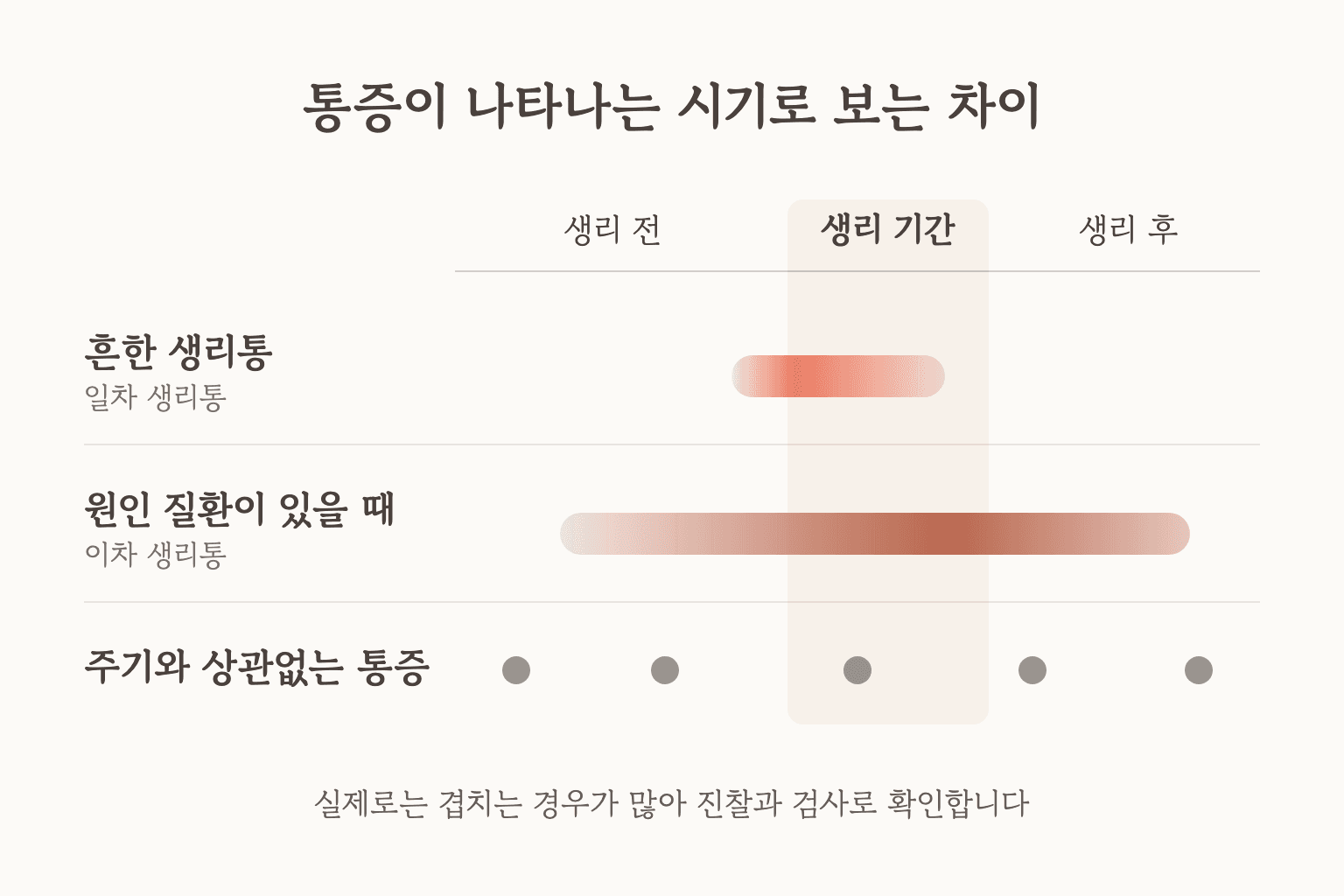
What changes mean another cause should be looked into?
Pay attention to the “change” rather than the “intensity” of the pain. Even if it is the same period pain as before, it is a good idea to see a doctor and have the cause checked if any of the following has been added.
- Period pain that you never had before has appeared, or it is getting steadily worse and lasting longer
- The pain makes daily life difficult even though you take painkillers
- Your periods have become noticeably heavier, or you bleed between periods
- It hurts during or after sex, or your pelvis hurts when you pee or poo
- Pelvic pain keeps coming back even when you are not on your period
- A bloated or heavy feeling in your belly lasts for weeks, your appetite drops, or you lose weight without trying
Period pain can increase during the first few months after an intrauterine device is inserted. Even so, if the pain continues or gets worse, please mention it at your appointment.
What conditions can be the cause?
The main causes of secondary dysmenorrhea are endometriosis, adenomyosis and uterine fibroids, and infections, ovarian cysts and bowel or bladder conditions are considered as well. The descriptions below are meant to help you understand what is checked at an appointment, not to be matched against your symptoms for self-diagnosis.
Endometriosis is a condition in which tissue similar to the lining of the uterus settles outside it, such as on the ovaries or the pelvic wall. Each period, this tissue becomes inflamed and bleeds, and this can lead to adhesions, where nearby organs stick to one another. Besides severe period pain, it can cause pelvic pain unrelated to periods, pain during sex, pain when passing stool or urine, and it can be a reason for difficulty getting pregnant.
Adenomyosis is a condition in which tissue from the lining of the uterus grows into the muscle wall of the uterus. As the uterus enlarges, heavier periods along with period pain are common, and the lower belly may feel heavy or swollen. It is often found from the 30s onward, and some people have no symptoms.
Uterine fibroids are benign growths in the muscle of the uterus. Small fibroids usually cause no pain, and they more often show up as heavier periods or a feeling of pressure in the lower belly than as pain. Depending on their position and size, they can make period pain worse.
In addition, infections of the uterus, fallopian tubes and ovaries, such as pelvic inflammatory disease, can bring pain unrelated to the cycle, together with fever and changes in discharge. Ovarian cysts usually cause no symptoms, but if one twists or bursts, sudden severe pain occurs. There are also other conditions, such as irritable bowel syndrome or bladder conditions, whose symptoms flare up around the period, so the search is not limited to gynecological causes.
In what order are the causes checked at an appointment?
The appointment starts with listening carefully to the history of your pain, then narrows the range of causes with an examination and ultrasound. Not everyone has the same tests; the tests needed are chosen based on what you describe and what the examination shows.
- Talking it through We check the age when your period pain first started, recent changes, how the pain overlaps with your cycle, which painkillers you take and how well they work, how heavy your periods are, other symptoms, the possibility of pregnancy and your plans for pregnancy. Notes about your pain are the most helpful at this stage.
- Examination We press on the belly to find where it hurts and, if needed, do an internal examination to check the size and mobility of the uterus and ovaries and whether pressing on them is painful. If the examination worries you or feels uncomfortable, please let us know beforehand.
- Ultrasound We look at the shape of the uterus and ovaries to check for fibroids, changes that suggest adenomyosis, and ovarian cysts caused by endometriosis.
- Further tests when needed If an infection is suspected, a discharge test or blood test is done; if pregnancy is possible, a pregnancy test comes first. If the cause needs closer investigation, we may refer you to a medical institution that can perform imaging such as MRI or a laparoscopy.
The aim of the appointment is to find the cause and, at the same time, to reduce the pain you have now. Treatment varies with the cause, your age and your plans for pregnancy, and may include painkillers, hormonal treatment or treatment of the underlying condition. Hormonal treatment may not be suitable for some people and has side effects, so it is decided after a thorough discussion.
If the tests show nothing wrong, is everything fine?
A normal ultrasound means that “no noticeable growth or structural change was seen,” not that there is no cause for the pain at all. In particular, small patches of endometriosis or adhesions may not show up well on ultrasound.
The blood level called CA-125 can also be used as a reference, but it can be raised without endometriosis and normal with endometriosis, so a diagnosis is not made from this value alone. Confirming endometriosis with certainty requires a laparoscopy to look directly inside the pelvis, but as this is a surgical procedure, it is not recommended as a first step for everyone.
That is why, when the tests are normal but the symptoms are clear, treatment to reduce the pain is often started first and the response is used to guide the next step. If the pain continues despite treatment or new symptoms appear, things are reassessed. The fact that one round of tests did not give an answer does not mean you have to put up with the pain.