
Your period ended last week, yet some days you get a pricking ache in your lower belly, or one side feels heavy and pulling. Period pain may feel familiar, but pain at other times often leaves you wondering, “Why is this happening?”
It is hard to tell the cause of this kind of pain from how it feels alone. So rather than trying to guess the cause on your own, today we will focus on knowing what the possibilities are and describing your pain clearly.
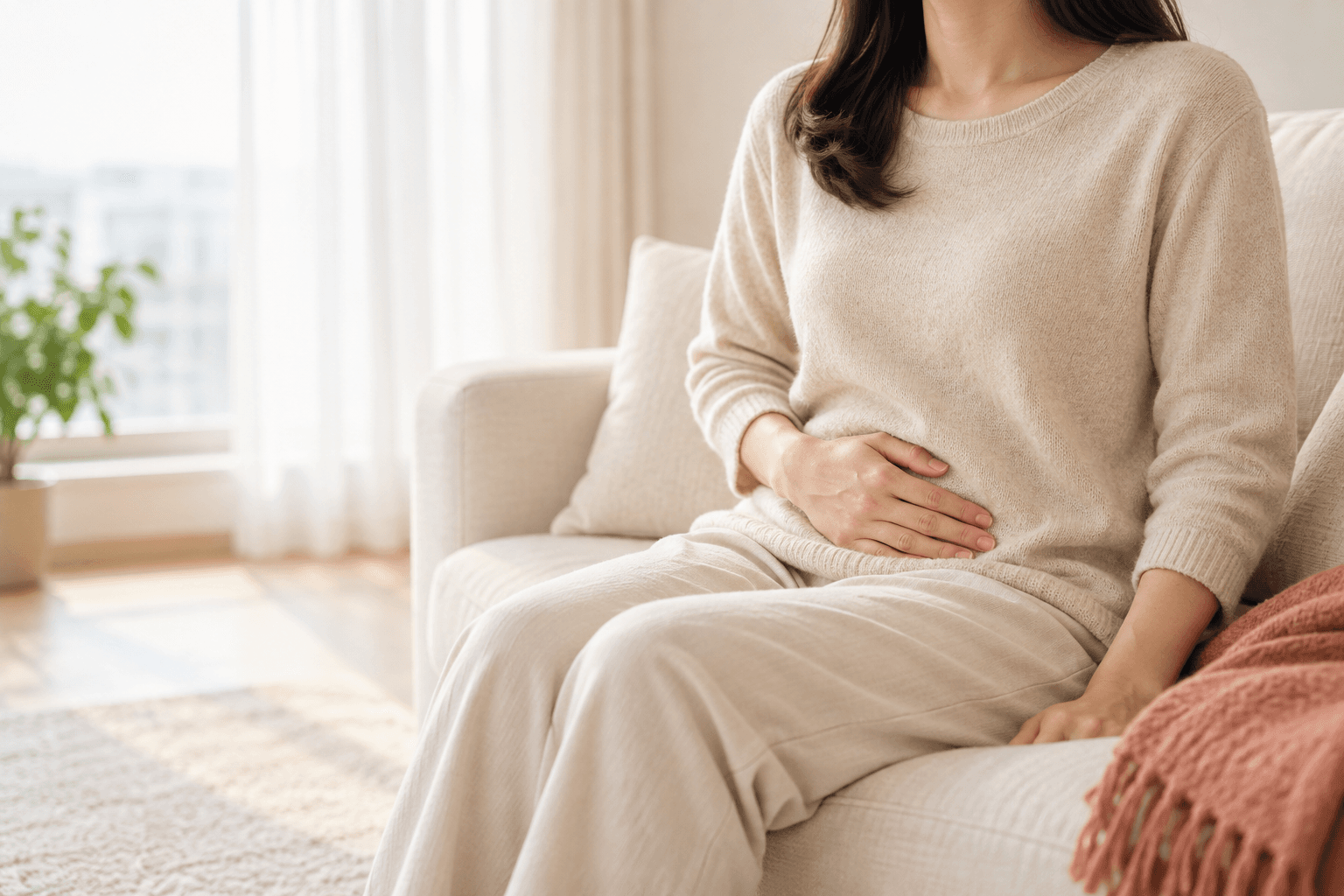
Why does my lower belly hurt when it’s not my period?
Many organs sit close together below the belly button, so lower belly pain can come not only from gynecological problems but also from the bowel or bladder. Because the uterus, ovaries and bowel are so close to one another, even the person in pain often finds it hard to tell where it is coming from.
Broadly, the possible causes can be grouped as follows. This list is only a grouping to aid understanding. It is not a chart for matching your symptoms and diagnosing yourself.
| Area involved | Possible examples |
|---|---|
| Uterus and ovaries | Pain around ovulation, ovarian cysts, endometriosis, pelvic inflammatory disease, etc. |
| Related to pregnancy | Changes in early pregnancy, ectopic pregnancy (where a pregnancy implants outside the uterus), etc. |
| Bowel | Constipation, gas, gastroenteritis, irritable bowel syndrome, appendicitis, etc. |
| Bladder and urinary tract | Urinary tract infections such as cystitis, urinary tract stones, etc. |
| Muscles and nerves | Tension in the pelvic floor muscles, etc. |
Most of these pass without much trouble, but some causes need to be checked quickly. Please keep in mind that you cannot judge whether pain is minor from its intensity alone.
Can my belly hurt when I ovulate?
Yes. Some people have pain on one side of the lower belly around ovulation, when an egg is released from the ovary. This is often called ovulation pain.
Ovulation pain usually appears about 2 weeks before your next period starts. One side of the lower belly may ache dully or give a sudden, sharp twinge, and it often passes within a few minutes to a day or two. The side that hurts may switch from month to month, and a small amount of bleeding or discharge may appear along with it.
However, do not assume, “The timing fits, so it must be ovulation pain.” Ovarian cysts, endometriosis, some sexually transmitted infections and ectopic pregnancy can also cause pain in a similar area. If the pain keeps getting stronger, lasts for several days, or does not ease even after taking painkillers, it is hard to see it as ovulation pain alone.
How should I describe the pain at my appointment?
Rather than saying “My stomach hurts,” describing when, where, how and how much it hurt goes a long way toward narrowing down the cause. Jot the items below down briefly in a note on your phone. It is fine if you cannot fill in every one.
- When did it hurt? Note how many days it was after the first day of your last period, and whether similar pain has happened at the same time before. If you keep period records, it helps to look at them together.
- Where did it hurt? Note whether it was on the right, the left or in the middle, and whether it spread to your lower back, buttocks or legs. It also helps to note whether it was a small spot you could point to with a finger or spread over a wide area.
- What did it feel like? Describe it however it comes to mind, such as stabbing, cramping, a heavy pressing ache or a burning feeling. Also note whether it hurt constantly or came and went.
- How bad was it? Note how long it lasted, such as minutes, hours or days, and whether it was bad enough to interfere with work or sleep. Write down the name of any painkiller you took and whether it helped.
- Were there any other changes? Check for vaginal bleeding or changes in discharge, fever, pain when urinating or needing to urinate often, constipation or diarrhea, and nausea. It also helps to note whether it hurt more when moving, during bowel movements or during sex.
Think in advance about whether you could be pregnant, too, because what needs to be checked first depends on whether you are pregnant. If your test result is unclear, see how to check a pregnancy test result.
When should I see a doctor?
If the pain keeps coming back, does not go away, or comes with other symptoms, see a doctor to find out the cause. Just because you can bear it does not mean you need to keep putting it off.
- When the same pain returns several times, or does not get better after several days
- When it does not ease even with painkillers, or keeps getting worse
- When it comes with bleeding that is not your period, unusual discharge or fever
- When urinating hurts, you urinate more often, or there is blood in your urine or stool
- When you could be pregnant and your lower belly hurts
- When you lose weight without trying, or a bloated feeling does not go away
At the appointment, you will first talk through the points you noted above. Then, as needed, an examination, urine test, pregnancy check, ultrasound or other tests are chosen. Not everyone has the same tests, and sometimes a single test cannot identify the cause right away. If the cause does not appear to be gynecological, you may be advised to see another specialty.