
On the first morning of your period, your belly starts to cramp as if it is being wrung out, you tell yourself to hold on a little longer, and by the afternoon you end up reaching for a pill anyway. It can feel as if taking painkillers often must be bad for you, and since it happens every month, it is easy to think this is just how periods are. But putting up with period pain is not the answer, and how well a painkiller works can depend quite a lot on when and how you take it.
In this article, we go through when and how to take painkillers for period pain, what you can do alongside medication, and the signs that it is time to see a doctor.
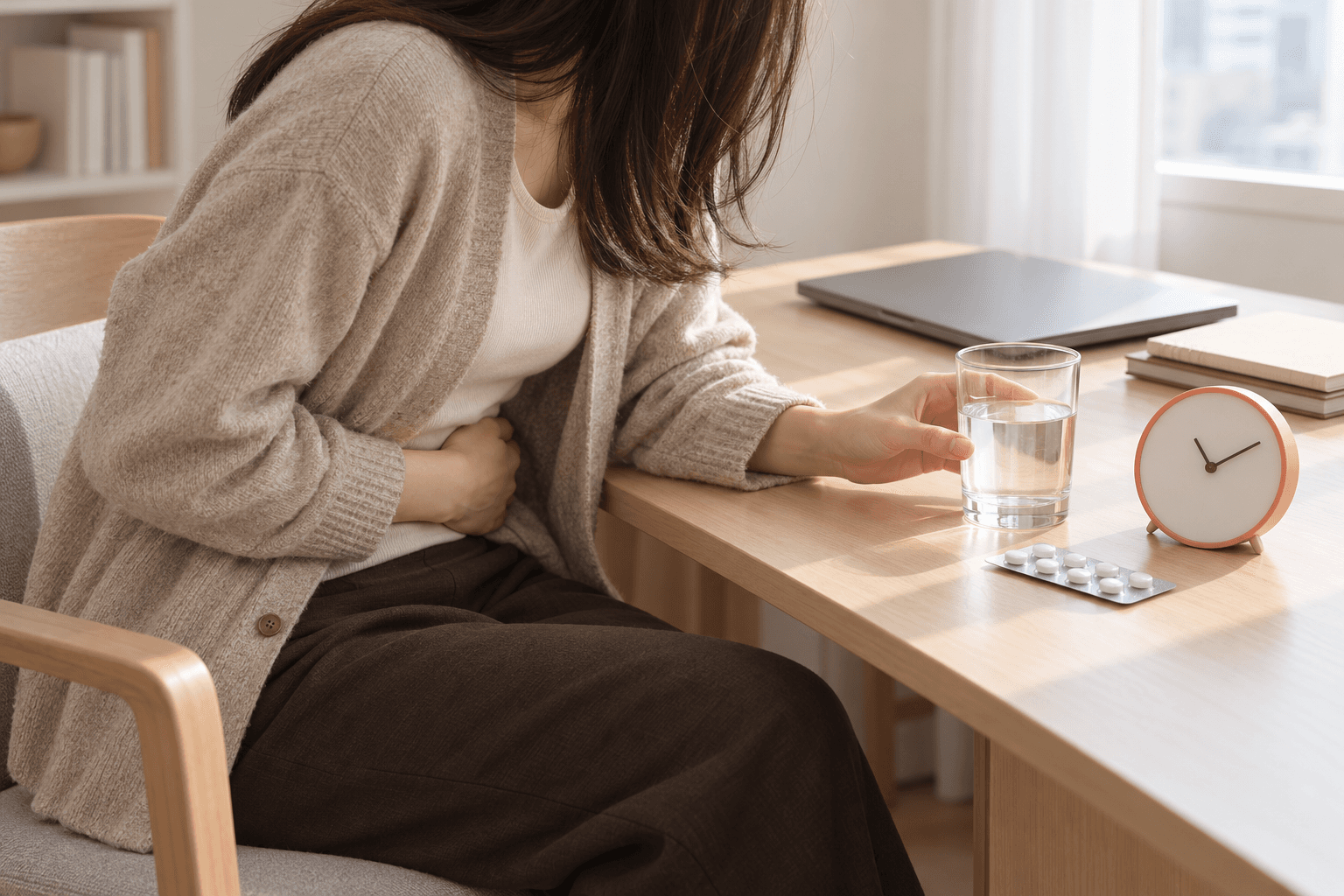
When should I start taking painkillers for period pain?
It is best to start around the time your period begins or the pain starts. If you hold on until the pain peaks and only then take something, the same medicine can feel less effective.
During a period, the lining of the womb produces more of a substance called prostaglandin, which makes the womb contract, and these contractions are felt as pain. Anti-inflammatory painkillers such as ibuprofen and naproxen work by reducing how much of this substance is made. Once a lot has already been produced, there is less for them to reduce, so starting early works in your favor.
- If your cycle is regular: You can talk with your doctor about starting when your period is due or when you feel the first signs that it is starting.
- Once you have started: Taking them regularly at the interval written on the package leaflet during the first day or two, when the pain is worst, helps keep the effect going.
- How much to take at once: Do not take several tablets at once because it hurts, and do not go over the maximum daily dose. Doses and intervals differ between products, so check the leaflet first.
Painkillers containing acetaminophen (paracetamol) can also be used for period pain. Because they work differently from anti-inflammatory painkillers, how well they work can vary from person to person, so remembering how you responded during your period can help you choose next time.
What should I check before taking painkillers?
Anti-inflammatory painkillers are easy to buy at a pharmacy, but they are not right for everyone. If any of the following apply to you, tell a pharmacist or your doctor before taking them.
- You have or have had a stomach or duodenal ulcer, or you often get heartburn
- You have asthma, or you have had breathlessness or hives after taking a painkiller such as aspirin
- You have liver, kidney or heart disease, or a condition that makes bleeding hard to stop
- You regularly take other medicines, such as blood thinners
- You are pregnant, could be pregnant, or are trying to get pregnant
- You often drink heavily
Avoid taking them on an empty stomach; taking them with or after a meal eases the burden on your stomach. Do not take two different anti-inflammatory painkillers together, and check that they do not overlap with medicines that already contain a painkiller, such as combination cold remedies. They can cause nausea or indigestion. If you have severe heartburn that keeps going after taking them, black and sticky stools, or vomit with blood in it, stop the medicine and see a doctor straight away.
What else can I try besides medication?
Keeping your lower belly warm and moving your body gently are the main things you can try alongside painkillers. Self-care alone may not settle severe pain completely, but combined with medication it can make it easier to get through.
- Keep warm: Put a heat pack or hot pack on your lower belly or lower back, or take a warm shower or bath. A hot pack left directly on the skin for a long time can cause a low-temperature burn, so place it over clothing or a towel.
- Move gently: Easy movement such as walking, stretching or yoga can help. Regular exercise in everyday life is also known to help ease period pain.
- Massage your belly and back: Gently rub your lower belly or lower back with your hands to release tension.
- Cut down on alcohol, smoking and caffeine: Smoking and drinking can make period pain worse, so it is good to cut down or quit, and cutting down on caffeine and salty food is also recommended.
On days when your body is struggling, loosening your schedule a little and resting is also part of looking after yourself. If you often have to miss school or work because of the pain, that alone is a reason to see a doctor.
Which kinds of period pain need a doctor’s visit?
If daily life is still difficult even when you take painkillers properly, or the pain has changed from how it used to be, see a doctor. Many cases of period pain are primary dysmenorrhea with no other problem in the pelvis, but some have an underlying condition such as endometriosis or adenomyosis.
- It hurts so much, even with painkillers, that you have to miss school or work or lie down
- You have taken them regularly at the right time, yet for several months the pain has not been well controlled
- You need more and more painkillers, or a medicine that used to work no longer does
- You have developed period pain you never had before, or it gets worse and lasts longer year by year
- The pain starts before your period or continues after your period has ended
- Your periods have become heavier, or you bleed between periods
- It hurts during sex or when you urinate or have a bowel movement, or your lower belly hurts even when you are not on your period
We explain in detail why the pain happens and how primary period pain and period pain caused by an underlying condition are told apart in the clinic in how the causes of recurring period pain and pelvic pain are told apart. If your lower belly hurts regardless of your period, also read when your lower belly hurts but it’s not your period.
What happens at a clinic visit?
At the clinic, we look at ways to ease the pain you have now and at checking its cause, together. Not every test is done from the start; we choose what is needed based on your story and the examination.
- Sorting out the pattern of the pain We ask when the pain started, whether it is worst before, during or after your period, and how much it gets in the way of daily life.
- Checking the medicines you have tried Tell us the name of the painkiller, when you took it, how much you took at once, how well it worked and anything that bothered you. A photo of the medicine package is also fine.
- Looking for the cause If needed, we check the womb and ovaries with an ultrasound or other tests to see whether there is another cause.
- Deciding how to manage it We review your medical history and other medicines, discuss a suitable painkiller and how to take it, and if needed consider hormone-related treatment or treatment of an underlying condition.
Hormone-related treatment can be used to reduce period pain, but there are conditions that make it hard to use, such as smoking, blood pressure or the risk of blood clots, and it has side effects, so it is decided after your condition is checked and you have had a thorough consultation. You can also see what is checked at a clinic visit in LILEAP’s guide to menstrual pain care.