
Some days, after sex, your lower belly feels heavy and pulling, or a spot deep on one side keeps giving sharp twinges. It can feel awkward to bring up, so it is easy to brush it off with “It will pass if I rest a bit.” Pain during or after sex is more common than many people think, and it is a symptom you can openly discuss at an appointment. The American College of Obstetricians and Gynecologists (ACOG) notes that nearly three in four women have pain during sex at some point in their lives.
This article covers pain that lingers deep in the lower belly and pelvis after sex. Soreness or dryness at the vaginal opening is covered separately in vaginal dryness and painful sex, and lower belly pain unrelated to sex in lower belly pain outside your period.
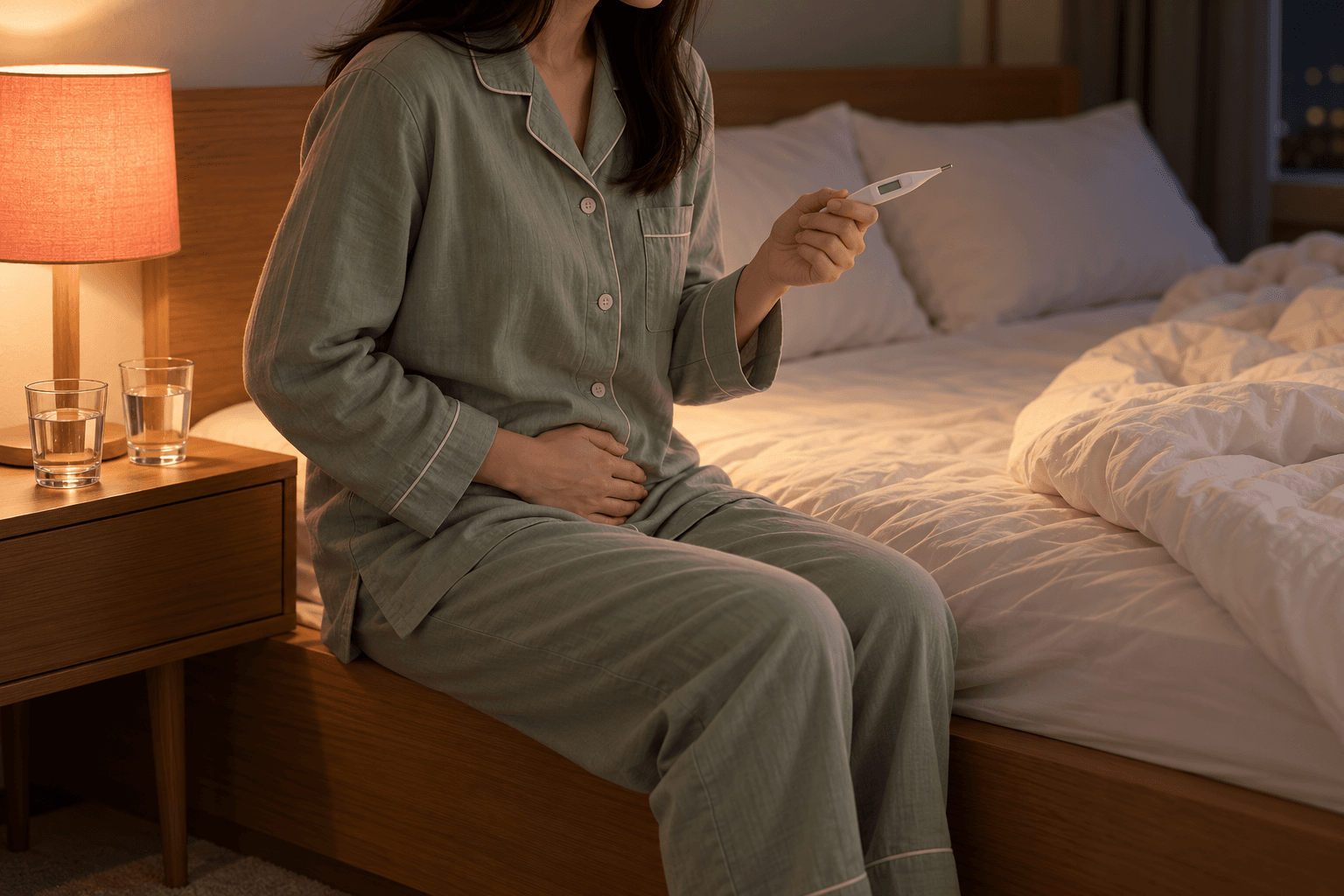
Is pain at the opening different from pain deep inside?
Yes. Where it hurts changes which causes are looked at first. Pain during sex is called dyspareunia, and it is broadly divided into pain at the vaginal opening, where contact first happens, and pain in the lower belly or deep in the pelvis during deep penetration or after sex.
Pain at the opening is often linked to causes near the surface, such as dryness, skin irritation or vaginitis. Deep pain, or pelvic pain that lingers after sex, on the other hand, may call for checking organs deeper in the pelvis, such as the uterus, ovaries and fallopian tubes. Both can happen together, so start by thinking about which one bothers you more.
What should I note down to help at my appointment?
Rather than the pain itself, details about what the pain is like help narrow down the cause. If you keep a short note on your phone, you can simply show it for the parts that are hard to say out loud.
- When did it hurt? Note whether it began with deep penetration during sex, right after, or a few hours later.
- Where did it hurt? Note whether it was on the right, the left or in the middle, and whether a heavy ache spread toward your lower back or anus.
- How long did it last? Write down whether it settled within a few minutes, was still there the next day, or grew stronger over time.
- Was there bleeding or a change in discharge? Check whether you noticed blood after sex, and whether the color, smell or amount of discharge was different from usual.
- Did you have a fever or feel achy and unwell? If you took your temperature, write down the reading, and also note whether you felt chilly or nauseous.
- Where were you in your menstrual cycle? Please also write down the first day of your last period, whether your period is late, and the contraception you use.
- Does it happen every time? It also helps to know whether it hurts every time you have sex or only in certain positions or at certain times, and whether you also have period pain or pain with bowel movements or urination.
Why does my lower belly hurt after sex?
There is no single answer, and the range runs from mild pain that passes to conditions that need treatment. If deep contact briefly irritates the pelvis and the ache settles soon without coming back, it is often nothing to worry about much. However, causes like the ones below are also possible, so if the pain keeps returning or comes with other symptoms, it needs to be checked.
| Possible underlying causes | What to look at alongside |
|---|---|
| Around ovulation | About 2 weeks before your next period, one side of the lower belly aches dully or sharply, usually passing within a few minutes to a day or two. |
| Ovarian cysts | Most cause no symptoms, but if a cyst is large, bursts or twists the ovary, it can cause pain during sex or sudden, severe pain. A corpus luteum cyst, which forms after ovulation, can also burst and leave blood pooled inside the belly. |
| Pelvic inflammatory disease | Usually caused by sexually transmitted infections such as chlamydia or gonorrhea spreading up to the uterus and fallopian tubes. It can cause deep pain, bleeding between periods or after sex, changes in discharge and fever. Some people have no or only mild symptoms. |
| Endometriosis | Along with severe period pain, there may be pain during or after sex and pain with bowel movements or urination. |
| Related to pregnancy | A pregnancy that implants outside the uterus (ectopic pregnancy) can show up as pain on one side of the lower belly and bleeding that is different from usual. |
| Bowel and bladder | Causes outside the uterus and ovaries, such as constipation or cystitis, may also feel worse after sex. |
This table is only a grouping to aid understanding. It is not a chart for matching your symptoms and diagnosing yourself. There are also causes not in the table, such as adhesions after surgery, and two or more can overlap. If your pain gets worse or changes with each period, please also read causes of recurring period pain and pelvic pain.
When should I get medical care right away?
If the pain suddenly becomes severe or keeps getting stronger, or comes with a fever, heavy bleeding or dizziness, getting medical care comes before “watching a bit longer.” If you could be pregnant and your lower belly hurts or you notice bleeding, get checked right away, whatever a home pregnancy test shows.
Even if it is not an emergency, please do not put off getting checked if:
- Deep pain happens every time you have sex, or the same pain keeps coming back
- The pain does not ease with painkillers or lasts into the next day
- You have bleeding after sex or unusual discharge or odor
- Your period pain has become worse than before, or it also hurts with bowel movements or urination
What is checked at the appointment?
First, we talk through what you have noted down, then choose the tests needed to narrow down the cause. Not everyone has the same tests, and the cause cannot always be found in a single visit.
- Talking it through: We ask about the timing, location and duration of the pain, your periods and contraception, recent sexual contact, and any past infections or procedures.
- Checking for pregnancy: If pregnancy is possible, this is checked first, because whether you are pregnant changes which causes we look at.
- Examination: We examine your belly and pelvis, and if needed the inside of the vagina, checking where it hurts when pressed. If you feel uncomfortable during the exam, you can ask us to stop at any time.
- Infection tests: A sample of discharge is used to check for infections such as chlamydia and gonorrhea.
- Ultrasound: We look at the shape of the uterus and ovaries and check for cysts or fluid collected in the belly. Depending on the situation, a blood test may be done as well.
Treatment is decided based on the cause that is found. For example, if pelvic inflammatory disease is suspected, antibiotic treatment is started, and depending on the infection behind it, you will also be advised about care for your partner and when you can have sex again. Even if your symptoms improve, do not stop prescribed medicine on your own. If the cause is not clear from the exam and ultrasound but the pain continues, you may be referred to a medical facility that can do further tests to look into it more.
Until the cause is found, taking a break from sex or stopping when it hurts is a natural choice too. Rather than pushing through the pain, listen to your body’s signals first. The care process for pelvic inflammatory disease is summarized in LILEAP's pelvic inflammatory disease information, and infection test items in our STI screening information.